Home / Deployments / Team and league programs
Deployment type A
Team and league jersey personalization, on site and against your roster.
You already bought the jerseys. What you need is a vendor who will show up at the facility, apply names and numbers correctly, hand back a matching count, and put it in writing.
Before we travelA.1
The roster is the job. Send it as a spreadsheet with surname, number, garment size, and colorway per athlete, and we validate it against the layout before anyone loads a truck. That pass catches three specific problems while there is still time to solve them.
Names that will not fit
Roughly nine characters is the practical ceiling on a jersey back before letter-spacing goes wrong. A validation pass flags every surname over the limit so your program decides — abbreviate, drop to a smaller height, or use a two-line treatment — instead of an operator improvising at the press.
Duplicate and conflicting numbers
Two athletes assigned the same numeral in the same colorway is common in a roster assembled across coaches. We surface it. It is your call to resolve, but it should not be discovered when both jerseys are already pressed.
Size curve versus inventory
We reconcile the roster's size demand against the garments you actually own. A roster asking for eleven XLs against nine in the carton is a purchasing problem, and it is cheaper to find it two weeks out.
Fabric test
Send two or three sample jerseys from the same production lot ahead of the date. We test heat, dwell, and pressure and check for dye migration and sublimation ghosting. Polyester varies by mill; two jerseys that look the same can behave differently under a platen. The test tells us how to run the press — and tells you honestly if a lot is a poor candidate for application.
On the dayA.2
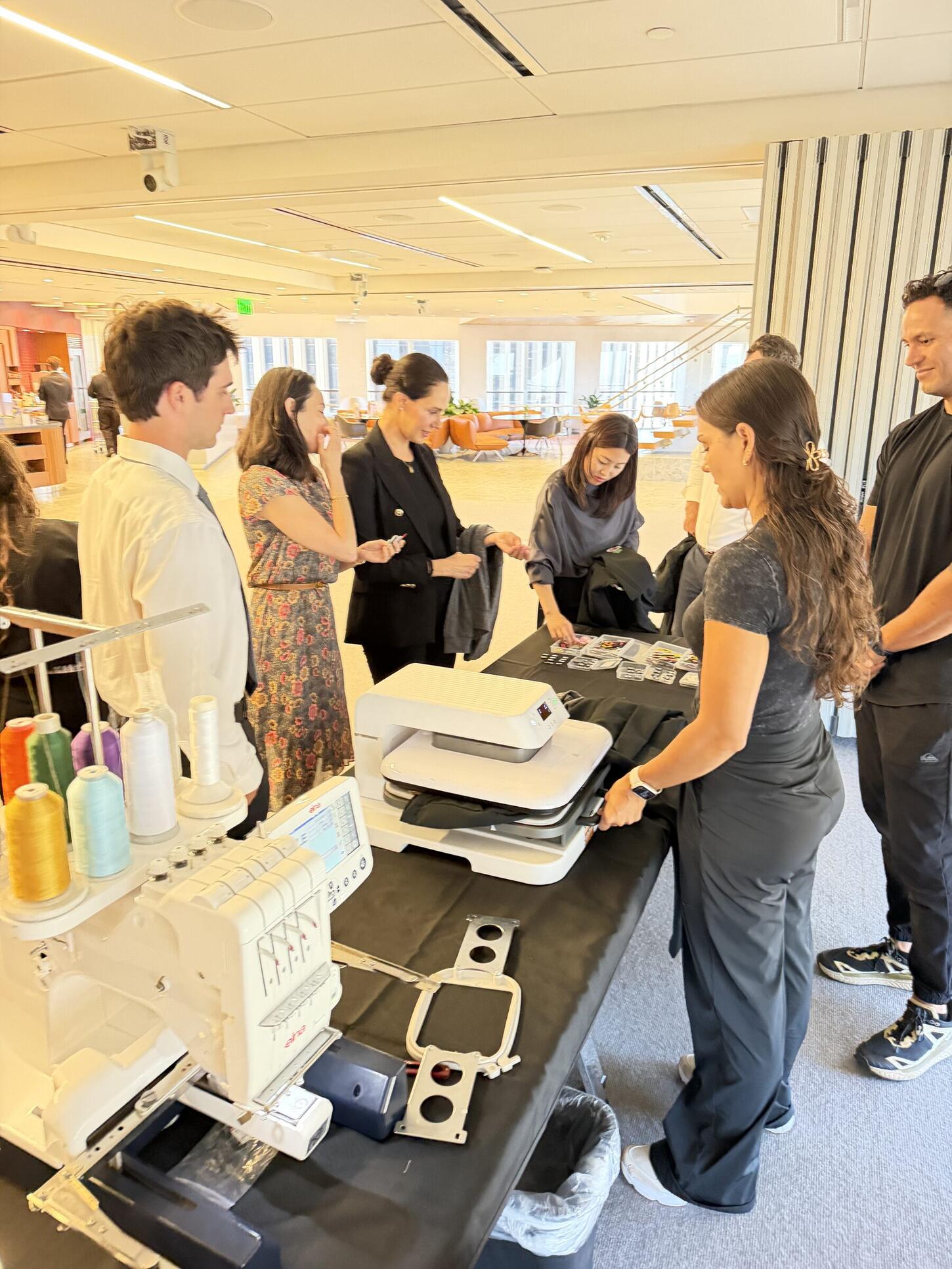
A roster day is the cleanest configuration we run. Tickets are already staged in the queue, so no one is typing at a tablet while a press waits. Garments are pre-sorted by size and colorway on the staging table. Two lanes handle most programs comfortably, and the crew lead runs a full-time QC pass instead of operating a lane — on a roster run the only real failure mode is a garment and ticket mismatch, and someone should be watching for it continuously.
Application is full-color DTF transfer and heat press by default, with alignment registered from the collar and side seams. Where a program wants the weight of a traditional back, we cut twill or tackle twill instead, which needs the letter kit prepared ahead of the date. Embroidered chest names run as a companion station.
If the program also wants a walk-up element — family members, staff, boosters — we press the roster first thing while the facility is quiet and flip the same lanes to walk-up when people arrive. One mobilization, two deliverables.
Handover and paperworkA.3
Goods accounting
Your garments are counted in against your packing list at load-in and counted out at teardown. Surplus goes back in the cartons it arrived in with a count that matches. Anything damaged in application is documented the same day with the reason, not discovered by you a week later.
Records export
At the end of the run you get the personalization count, the reprint log with causes, the remaining inventory by size, and an export of the intake records — every name, number, size, and location applied. Uniform programs that have to answer for a budget line generally want that file.
Commercially this sits in the same structure as everything else we quote: staffed stations from around $5,000 for a local build, staffing at $250 per hour across setup, live time, and teardown, travel free inside Orange County, Los Angeles, and San Diego and $900 outside it. Supplying your own jerseys removes the blank cost from the quote entirely. See the full pricing inputs →
Next step
Send the roster and the jersey lot. We will validate both.
Send garment source, unit count, venue, and hours on the floor. We reply with lane count, crew size, and a written figure.